

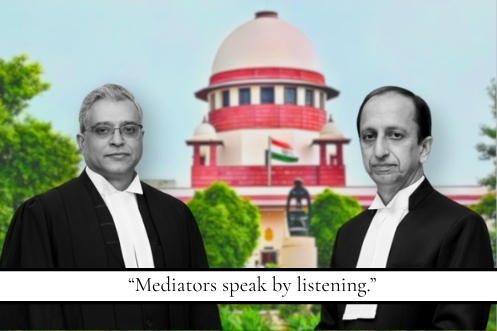
Case: Raksha Devi v. Parkash Chand
Citation: Civil Appeal No. 7435 of 2012
Bench: Justice Pamidighantam Sri Narasimha and Justice Atul S Chandurkar
Date of Judgment: 24 September 2025
Introduction
The Supreme Court of India, through its judgment in Raksha Devi v. Parkash Chand, delivered not only a resolution to a prolonged property dispute but also a profound message about the soul of mediation and the evolving culture of dispute resolution in India.
The case, which had lingered in litigation for nearly forty years, was finally settled through the efforts of Senior Advocate Gaurav Agrawal, who was appointed as the Court mediator. However, what makes this judgment remarkable is not merely the end of a legal battle but the reflection it offers on the philosophy of listening, empathy, and human connection that lies at the core of mediation, and other forms of alternative dispute resolution.
The judgment contains a line that stands out for its simplicity and depth:
“Mediators speak by listening.”
In those four words, the Court has captured the very essence of effective mediation. It reminds us that resolution is not born from argument or authority but from attention, understanding, and trust.
Background of the Case
The dispute between the parties, Raksha Devi and Parkash Chand, originated in Hamirpur, Himachal Pradesh, and concerned agricultural land and related property rights. Over the decades, the matter saw multiple rounds of litigation without success.
When the appeal came before the Supreme Court, the bench led by Justice Narasimha and Justice Chandurkar decided to attempt a different path. In October 2024, the Court appointed Senior Advocate Gaurav Agrawal as a mediator and encouraged both sides to participate sincerely in the process.
Mr. Agrawal’s approach went beyond the ordinary. He personally travelled to Hamirpur, met with the family members, and physically inspected the property in question. His humility and effort to engage with the parties on human terms built the trust necessary for reconciliation.
The mediation succeeded. The parties agreed to divide the land and property amicably, and the Court recorded the settlement, closing a chapter that had lasted for four decades.
A Lesson in Human Approach
In recording the appreciation for the mediator, the Supreme Court observed that lawyers must learn to cultivate new skills and attitudes if they wish to evolve into mediators. The judgment praised the young counsels, Mr. Akhil Sachar and Mr. G Arudhra Rao, for recognising the value of trust and simplicity over confrontation and argument.
The Court’s reflection went beyond the case. It turned into a broader message about the transformation of dispute resolution in India. It stated that if lawyers aspire to become effective mediators, they must move away from the adversarial mindset and learn to resolve through persuasion and empathy.
Understanding “Mediators Speak by Listening”
The phrase “Mediators speak by listening” carries profound meaning. It reverses the traditional expectation of the legal profession where persuasion is seen as a product of eloquence. In mediation, persuasion arises not from speaking but from listening with intent.
To listen, in the context of mediation, is to understand the fears, interests, and emotions that lie beneath the surface of legal arguments. It requires patience and the willingness to see the dispute not as a contest of rights but as a conflict of needs.
Listening helps mediators recognise the emotional truths that often drive disputes. It allows them to create space for understanding and compromise. In this sense, the mediator does not impose a solution but enables the parties to find it themselves.
The Court’s statement is therefore both philosophical and practical. It asks every lawyer, judge, and mediator to remember that resolution begins where argument ends and empathy begins.
The Concept of Swadeshi Mediation
The judgment introduces another important idea — “Swadeshi Mediation”.
According to the Court, the model of mediation envisioned for India should not be a mechanical import of western systems but a process shaped by Indian values of compassion, simplicity, and human connection.
The word Swadeshi in this context does not merely signify nationality; it represents a mindset of rootedness. It stands for an approach to conflict that aligns with the Indian way of life, where disputes are traditionally resolved through dialogue, respect for elders, and community understanding.
Swadeshi Mediation calls for a fusion of professional skill with personal goodness. It recognises that a mediator’s credibility is not only in legal expertise but also in character, integrity, and sincerity.
The Court’s observation that “goodness is an essential value” is a reminder that mediation is not a detached or mechanical exercise. It is a human process guided by moral strength and emotional intelligence.
The Role of Lawyers in the New Era
This judgment has strong implications for the legal profession. It calls upon advocates to view mediation not as a peripheral activity but as an integral part of modern dispute resolution.
A lawyer trained in adversarial techniques is skilled at argument, but a lawyer who listens becomes capable of healing. The shift from adversarial practice to collaborative resolution demands patience, emotional awareness, and cultural sensitivity.
The Court’s remarks encourage lawyers to revisit their traditional training and develop new competencies such as listening, empathy, neutrality, and creativity. These qualities are not in conflict with professionalism; they enhance it.
As the Court observed, “goodness is not divorced from professionalism.” A true professional is one who can combine knowledge with kindness and strength with understanding.
Cultural Context and the Spirit of Harmony
The concept of Swadeshi Mediation also aligns with India’s long tradition of resolving disputes within communities through conversation and consensus. Panchayats, family councils, and local elders have historically performed the role of mediators, guiding people toward harmony rather than judgment.
In this sense, Swadeshi Mediation is not a new creation but a rediscovery of an ancient Indian approach that values relationship over rivalry. It is a return to the idea that justice is a shared pursuit, not a personal victory.
By grounding mediation in cultural familiarity, the Court envisions a process that ordinary citizens can relate to and trust. It transforms mediation from a formal procedure into a restorative experience that heals relationships as much as it settles rights.
Why the Judgment Matters
This decision is significant for several reasons:
- It redefines the role of mediation as a process of understanding rather than negotiation alone.
- It places moral and cultural values at the centre of legal practice, restoring the idea of law as a means of harmony.
- It challenges lawyers to evolve into listeners, negotiators, and peacemakers.
- It provides an indigenous framework for mediation that reflects Indian social and emotional realities.
- It bridges professionalism with compassion, showing that effective lawyering is as much about character as it is about competence.
Conclusion
The judgment in Raksha Devi v. Parkash Chand is a milestone in India’s journey towards a culture of mediation. It celebrates the quiet power of listening, the value of empathy, and the dignity of human connection.
In reminding us that mediators speak by listening, the Supreme Court has offered a timeless principle for both law and life. It teaches that listening is not a passive act but an act of courage, the courage to understand without judgment and to connect without ego.
As India moves toward a more inclusive and humane system of dispute resolution, this case will stand as a guiding light. It reaffirms that justice does not flow only from authority but also from empathy, sincerity, and trust. When mediators listen, people feel heard. And when people feel heard, conflicts begin to dissolve. That is where justice truly begins.
Author: Kunal Peelwan