

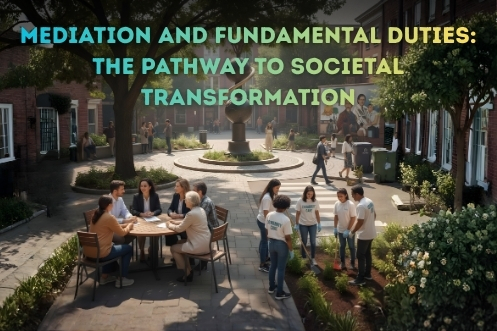
The Paradox of Modern Conflicts: Rights Without Responsibilities
The world has become a theater of perpetual protest. Across continents and cultures, from Mumbai to New York, from Hong Kong to São Paulo, millions march with raised banners demanding their fundamental rights. Yet amid this cacophony of rights-consciousness, a profound silence surrounds the conversation about duties. This asymmetry—the amplification of entitlements while the diminution of obligations—represents one of the most significant blind spots in contemporary conflict resolution. The observation is stark and uncomfortable: people protest vociferously for their rights to life, liberty, expression, and dignity, but remarkably few advocate publicly for their duties toward their families, communities, nations, and the very earth that sustains them.
This is not merely a philosophical observation; it is a structural impediment to peace, harmony, and the cultural flourishing that societies desperately seek.
Understanding Fundamental Duties: The Constitutional Intent
The Indian Constitution’s framers were acutely aware of this imbalance. While Part III enshrines Fundamental Rights as the bulwark against state oppression, Part IV-A introduces Fundamental Duties—eleven moral and ethical obligations that citizens owe to their nation and to one another. These duties are not hollow abstractions but rather practical guides to social cohesion.
Yet here lies the critical insight: these duties are non-enforceable by courts. Unlike rights, which citizens can assert before judges, duties remain in the realm of conscience, moral persuasion, and social expectation. This legal non-enforceability has inadvertently created a cultural narrative where rights became the legitimate language of demand while duties became relegated to pious exhortations from government and religious institutions.
The Imbalance: Rights Talk as a Barrier to Resolution
Modern conflict resolution scholarship reveals a troubling phenomenon. When disputes are framed exclusively through the language of rights, they become increasingly intractable. Rights-based discourse functions as what legal theorists call a “trump card”—an absolute formulation that tolerates little compromise. A person who frames their demand as a “right” does not negotiate; they demand. They do not compromise; they capitulate or stand firm. This absolutism, while psychologically empowering for the individual asserting it, becomes deeply destructive in communities where multiple rights intersect and collide.
Consider the modern protest landscape. Whether it is workers demanding higher wages, students protesting fee structures, environmental activists fighting for clean water, or marginalized communities seeking justice, the language is consistently one of rights. This framing is not unjust—indeed, many of these demands represent legitimate aspirations. However, the critical flaw is structural: rights talk lacks a corresponding responsibility framework.
In the United States and increasingly across the world, there is a profound absence of developed “responsibility talk” or “duty consciousness”. Citizens demand rights from the state but often balk at jury duty. They proclaim the right to public services but resist tax obligations. They champion freedom of expression while neglecting to exercise the duty to listen respectfully to opposing viewpoints. They assert their right to raise children but shrink from the duty to teach them compassion and integrity.
This creates a society of competing demands with no ethical foundation for mutual restraint or collective welfare.
The Missing Link: One’s Right is Another’s Duty
A profound truth, often forgotten in the frenzy of rights advocacy, sits at the foundation of all social order: one person’s right necessarily imposes another person’s duty. If I have a right to life, others have a duty not to harm me. If I have a right to property, others have a duty not to steal from me. If I have a right to be heard, others have a duty to listen. This reciprocal architecture means that a society cannot sustainably function when half of this equation is emphasized while the other half is ignored.
The Indian Constitution’s framers understood this. They deliberately positioned rights and duties as complementary, not contradictory. Yet in practice, constitutional law courts have developed robust jurisprudence protecting rights while remaining largely passive on duties. Even the Supreme Court has occasionally reminded society that while duties are not judicially enforceable, they serve as “moral obligations” and interpretive tools that courts should not undermine.
Mediation: The Practice of Duty-Consciousness
This is where mediation emerges not merely as a dispute resolution technique but as a transformative social practice rooted in duty consciousness. Unlike litigation, which is fundamentally rights-focused (Did the defendant violate my right? What remedies can courts provide?), mediation begins from a different premise: what responsibilities do both parties have toward each other, their families, their community, and the resolution process itself?
A mediator does not begin by asking, “Who is right?” Rather, a skilled mediator inquires, “What has happened here? What are each party’s needs? What impact has this conflict had on your family, your workplace, your community? What do you each owe to those who depend on you—including each other?” This reframing from rights to duties fundamentally alters the psychological and relational landscape of the dispute.
In family mediation, this reorientation becomes particularly powerful. Rather than asking parents to litigate custody as a battle of rights (My right to parent versus Your right to parent), a mediator helps them recognize their duties toward their children, toward maintaining functional co-parenting relationships, and toward preserving the family’s social fabric. The outcome is not determined by which parent “wins” but by what serves the common interest of the family—especially the children. Parents emerge not as victors and vanquished but as co-creators of a new relational reality grounded in shared responsibility.
Similarly, in workplace and organizational contexts, mediation transforms “rights-based grievances” into “responsibility-centered solutions.” When employees demand higher wages as a right, and management asserts their right to control labor costs, the conflict appears binary and irreconcilable. But when a mediator facilitates dialogue around mutual duties—the employee’s duty to contribute excellence, management’s duty to ensure fair compensation and working conditions, and both parties’ duty to the organization’s sustainability—creative solutions emerge.
The 90% Hypothesis: Resolving Disputes Through Duty Consciousness
The core observation animating this article deserves serious contemplation: if citizens practiced their fundamental duties consciously and faithfully, approximately 90% of contemporary disputes would dissolve or be resolved amicably. This is neither naive idealism nor utopian fantasy but rather grounded in conflict resolution theory and human psychology.
Consider the specific duties:
Duty to promote harmony and brotherhood: If this were practiced, how many communal, caste, and religious conflicts would persist? How much violence rooted in intolerance could be prevented if people genuinely committed to transcending sectarian divisions and affirming common brotherhood?
Duty to safeguard public property and abjure violence: How many disputes escalate into violence, destruction of infrastructure, and societal degradation because people abandon this duty? If citizens accepted responsibility for non-violence and public welfare, police brutality would diminish (for it requires both state excess and public provocation), vandalism would cease, and public resources could be directed toward progress rather than repair.
Duty to strive for excellence in all spheres: How many workplace disputes, educational conflicts, and professional disagreements arise from laziness, incompetence, or deliberate underperformance? If employees practiced their duty to excellence, if students committed to their duty to learn, if professionals embraced their duty to serve clients and society with integrity—conflicts would shift from blame and compensation to continuous improvement.
Duty to provide education to children: How much familial poverty, criminal behavior, and social dysfunction originates in the neglect of this duty? If parents universally accepted responsibility for educating their children, the systemic drivers of many disputes would be uprooted at their source.
Duty toward the natural environment: Environmental conflicts—from pollution disputes to land degradation—often arise because entities prioritize immediate profit over ecological responsibility. If this duty were honored, countless conflicts between developmental projects and environmental preservation would be prevented through voluntary compliance rather than adversarial litigation.
The mathematics of social harmony is thus reframed: not through more laws, more police, more courts, or more aggressive assertion of rights, but through the practical embodiment of duties by each person in their sphere of influence.
From Legal Non-Enforceability to Cultural Inevitability
A critical challenge emerges: If fundamental duties are non-enforceable by law, how can they become culturally dominant? The answer lies in recognizing that not all important social norms require legal sanctions. Indeed, the most resilient social structures are those maintained by conscience, reputation, tradition, and collective expectation rather than by coercive force.
Societies with strong duty-consciousness have historically achieved greater stability, harmony, and cultural sophistication without necessarily possessing more stringent laws. Lord Krishna’s teaching in the Bhagavad Gita aptly illuminates this: ‘You have a right to perform your prescribed duties, but you are not entitled to the fruits of your actions.’ This shifts the motivational framework from external enforcement to internal moral commitment. One person’s duty becomes another’s right, spontaneously and without need for legal intervention.
To build this cultural transformation, society must:
1. Reconceptualize Public Discourse: Media, educational institutions, and public figures must begin framing social issues through the language of shared duties alongside rights. When protesting injustice, movements could ask not only “What rights are being denied?” but also “What duties are we neglecting that perpetuate this injustice?”
2. Integrate Mediation into Institutional Structures: Rather than treating mediation as a backup to litigation, organizations—from schools to workplaces to government agencies—should embed mediation into their conflict resolution infrastructure. This normalizes duty-centered problem-solving early in disputes, before they ossify into rights-based demands.
3. Educate for Duty-Consciousness: Educational curricula should explicitly teach children and adolescents about their duties—to family, community, environment, and self. This is not moral preaching but practical life skills training in interdependence and mutual responsibility.
4. Model Duty-Consciousness at Institutional Levels: Government officials, corporate leaders, and community figures must visibly practice their duties. When leadership is perceived as duty-conscious—prioritizing public welfare over personal gain, protecting the vulnerable, stewarding resources responsibly—citizens are more likely to internalize similar values
5. Develop a Mediation Culture: Mediators and Mediation Organizations should position mediation not as a commercialized dispute resolution service but as a social movement toward duty-centered conflict resolution. Every mediation becomes an opportunity to teach society that harmony emerges not from rights victory but from mutual responsibility embodied through dialogue.
Mediation as Structural Repair
When mediation functions optimally, it operates as a corrective to the rights-based imbalance. A mediator creates space where people can articulate not only what they demand but also what they acknowledge owing to others. Through this process, conflicts shift from oppositional (I assert my right against your violation) to collaborative (We both acknowledge our roles in creating this situation and our shared responsibility for healing it).
This is particularly revolutionary in corporate social responsibility disputes, where conflicts often pit business rights against social duties. When these disputes are mediated rather than litigated, the resolution often transcends the binary of profit versus responsibility, yielding innovative models where business success and social welfare are pursued together.
The Cultural Payoff: Richness, Innovation, and Peace
A society that practices duty-consciousness experiences demonstrable benefits that transcend dispute resolution:
Cultural Richness: When individuals understand themselves as embedded in networks of mutual obligation rather than as isolated rights-bearers, culture flourishes. Art, literature, music, and philosophy emerge more robustly from communities that see themselves as custodians of a shared heritage with obligations to past and future generations.
Innovation: Paradoxically, duty-consciousness unleashes innovation more powerfully than rights-consciousness. When people feel responsible for excellence and collective progress (Article 51A(j)), they invest creativity toward solving shared problems. The duty to develop scientific temper and humanism (Article 51A(h)) motivates the very research, technology, and social innovations that societies desperately need.
Peace: Most fundamentally, peace becomes the default state rather than an aspirational goal. When violence is seen not as an expression of justified rights but as a breach of duty to non-violence and public safety (Article 51A(i)), when conflicts are mediated rather than litigated, when harmony and brotherhood are practiced duties rather than sentimental ideals—the infrastructure of peace becomes structural, not circumstantial.
The Mediator’s Sacred Responsibility
For mediators and mediation practitioners, this analysis points toward a profound responsibility. Mediation is not merely a technical dispute resolution process to be deployed neutrally irrespective of social consequences. Rather, mediation is a practice of social transformation. Every successful mediation teaches participants and observers that conflicts can be resolved through duty consciousness rather than rights assertion, through dialogue rather than adjudication, through mutual responsibility rather than blame.
The Path Forward
The global obsession with rights, while historically necessary and philosophically important, has created a profound structural imbalance in how societies manage conflict and build community. The answer is not to diminish rights but to resurrect and practice the correlative duties that rights presume.
Mediation, grounded in duty-consciousness, offers a practical and scalable pathway toward this transformation. As more conflicts are resolved through mediation rather than adjudication, as more people experience the profound relief that comes from acknowledging mutual responsibility rather than battling for individual vindication, as more communities discover that harmony emerges from duty practiced faithfully—a new social operating system becomes possible.
In this future, protests will not disappear, for there will remain injustices to be challenged. But they will be tempered by duty consciousness. Communities will assert their rights while acknowledging their responsibilities. Individuals will demand justice while accepting accountability. Families will communicate through frameworks of mutual obligation. Organizations will resolve disputes by appealing to shared duty rather than competing entitlements.
And in this transformation, approximately 90% of disputes will dissolve. What remains will not be unresolved conflict but rather the creative tensions of a society striving together toward excellence, sustainability, and harmony—each member practicing the fundamental duty to build a nation and world where all can flourish.
This is the promise of mediation grounded in duty consciousness. This is the work that transforms not just conflicts but civilization itself.