

The Crisis of Modern Conflict Resolution
In the contemporary landscape of dispute resolution, mediation has emerged as a vital mechanism for fostering equitable solutions while significantly reducing the time, cost, and emotional toll associated with traditional litigation. Mediators facilitate dialogue between conflicting parties, helping them navigate toward mutually acceptable agreements. Yet despite sophisticated procedural frameworks and negotiation techniques, modern mediation frequently encounters a fundamental crisis: positional bargaining—a psychological impasse where parties cling rigidly to predetermined demands, transforming negotiations into contests of will rather than collaborative problem-solving.
Research reveals that positional bargaining is characterized by extreme opening positions, minimal concessions, and an adversarial “you versus me” mentality that generates anger, resentment, and prolonged inefficiency. When parties perceive concessions as signs of weakness rather than opportunities for value creation, the mediation process becomes paralyzed. Technical interventions like “bracketing“—attempting to guide parties toward reasonable settlement ranges—address only surface symptoms, not the underlying psychological structures driving rigidity.
The persistence of such obstacles suggests that procedural mechanisms alone cannot overcome deeply entrenched psychological barriers. What modern mediation desperately needs is not merely better techniques, but a transformation of consciousness—both for mediators and the parties they serve. This transformation has been understood, practiced, and refined for millennia in India’s classical philosophical traditions.
The convergence of three sacred texts—the Yoga Vasistha, the Patanjali Yoga Sutras, and the Bhagavad Gita—offers a comprehensive, integrated framework for understanding and transcending conflict at its deepest roots. These ancient wisdom traditions provide modern mediators with the psychological, ethical, and metaphysical infrastructure necessary to elevate their practice from technical facilitation to transformative guidance.
The Metaphysics of Conflict: Yoga Vasistha and the Mind’s Creation of Discord
The Yoga Vasistha, a profound dialogue between Sage Vasistha and Prince Rama, presents a radical metaphysical analysis: all conflict originates in the fluctuations of the mind (manas). External disputes over resources, rights, or relationships are ultimately manifestations of internal mental constructs—illusions (maya) generated by egoic attachment (ahamkara).
As Sage Vasistha teaches:
श्रीवसिष्ठ उवाच । परमे ब्रह्मणि स्फारे समे राम समस्थिते । अनुत्पन्ननभस्तेजस्तमःसत्ता चिदात्मनि
“Vasishtha said: O Rama! When the Supreme Brahman remains in his resplendent and tranquil state, there is no essence of ethereal light or heat or even darkness produced in the intellectual spirit.”
This verse reveals a profound truth for mediators: genuine neutrality emerges not from procedural detachment but from an inner state of tranquility—a consciousness undisturbed by the heat of conflict or the darkness of negativity. The mediator who has cultivated this inner stability can witness even the most volatile disputes without being pulled into their drama.
The text further illustrates this through King Janaka’s realization:
“Oh, I have detected the thief who robbed me of my Atmic Jewel, viz., my Self. His name is Manas (Mind). I have been long suffering through this villain.”
This passage illuminates a critical insight: the true adversary in any dispute is not the opposing party, but one’s own mind’s attachment to conceptual boundaries. Positional bargaining becomes rigid because parties are defending not merely practical interests but ego-driven constructs of identity, dignity, and self-worth. The position “I need X” is often code for “Without X, I am diminished.”
Vairagya: The Practice of Dispassion
The Yoga Vasistha prescribes vairagya (dispassion) and vichara (self-inquiry) as pathways to dissolving this mental rigidity. The text describes the ideal state:
न शोचन्ति न वाञ्छन्ति न याचन्ते शुभाशुभम् । निष्कामा निष्क्रियाश्चैव सर्वत्र विहरन्ति ते
“They neither grieve nor wish nor ask for aught of good or evil. They do their work as if doing nothing (with indifference).”
For modern mediators, this describes the ideal stance: engaged yet detached, present yet non-attached to outcomes. The mediator facilitates dialogue without becoming invested in any particular resolution, maintaining what the text calls “calm serenity”.
Practical Application: From Positions to Inquiry
When mediators encounter positional bargaining, the Yoga Vasistha framework suggests reframing the challenge. Rather than viewing the dispute as primarily about external resources, the mediator recognizes it as an expression of internal attachment (sanga) to conceptual boundaries. By using facilitative questioning—”Why do you need that? What would having that provide?”—mediators initiate vichara (inquiry), guiding parties to examine the assumptions underlying their positions.
This approach moves beyond interest-based negotiation (which asks “what do you want?”) to consciousness-based mediation (which asks “who do you believe you are if you don’t get what you want?”). It addresses what the text calls the “cause behind the cause“—the fundamental illusion (maya) preventing parties from seeing their shared reality.
The Ethical and Psychological Foundation: Patanjali Yoga Sutras
While the Yoga Vasistha provides the metaphysical lens, the Patanjali Yoga Sutras offer practical, systematic guidance for cultivating the internal discipline required of effective mediators. Patanjali’s framework begins with ethical restraints (yamas) and proceeds to sophisticated techniques for managing mental and emotional states.
The Foundational Sutra: Chitta Vritti Nirodha
Patanjali defines yoga itself with elegant simplicity:
योगश्चित्तवृत्तिनिरोधः
“Yoga is the cessation of the fluctuations of the mind.”
This principle—chitta vritti nirodha—is transformative for mediators. The ability to still one’s mental fluctuations allow the mediator to listen without interference from personal judgments, biases, or reactive patterns. Research confirms that mindfulness practices rooted in this principle significantly reduce stress, anxiety, and rumination while enhancing attention, emotional regulation, and working memory—all essential capacities for mediators.
Studies demonstrate that mindfulness meditation reduces negative effects and depressive symptoms while improving concentration and mental clarity. Healthcare professionals trained in mindfulness-based stress reduction show marked decreases in anxiety, depression, and stress. For mediators navigating emotionally charged environments, these benefits translate directly into enhanced professional effectiveness.
The Four Attitudes: Chitta Prasadanam
Patanjali’s most celebrated guidance for managing interpersonal dynamics appears in Sutra 1.33:
मैत्रीकरुणामुदितोपेक्षाणां सुखदुःखपुण्यापुण्यविषयाणां भावनातश्चित्तप्रसादनम्
“By cultivating friendliness toward the happy, compassion for the suffering, delight in the virtuous, and equanimity toward the unwholesome, the mind becomes serene and clear.”
This sutra provides a precise psychological toolkit for mediators encountering diverse personalities and behaviors in conflict:
Maitri (Friendliness): Cultivating warmth toward those experiencing success or happiness fosters rapport and validates positive movement. When one party makes a concession or demonstrates flexibility, the mediator’s genuine friendliness reinforces that collaborative behavior.
Karuna (Compassion): Extending empathy toward those suffering creates psychological safety, allowing vulnerable parties to express underlying fears and needs. Research confirms that empathy and active listening are crucial for successful mediation, with emotionally intelligent mediators achieving up to 30% higher resolution rates and 68% increases in successful outcomes compared to those without such training.
Mudita (Delight): Celebrating virtuous qualities and ethical conduct observed during mediation encourages continued good-faith negotiation. This attitude prevents cynicism and maintains the mediator’s capacity to recognize and honor integrity.
Upeksha (Equanimity): Maintaining calm impartiality toward unreasonable or harmful behavior is perhaps the most critical skill for mediators facing aggressive tactics, manipulation, or bad-faith bargaining. Upeksha enables mediators to remain professionally detached, focusing objectively on process rather than reacting emotionally to provocations.
The Ethical Foundation: Yamas
Patanjali prescribes five ethical restraints (yamas) that form the foundation of right conduct:
अहिंसासत्यास्तेयब्रह्मचर्यापरिग्रहा यमाः
“Non-harming, truthfulness, non-stealing, conservation, and non-grasping are the restraints.”
For mediators, two are particularly crucial:
Ahimsa (Non-harming): This mandates creating a non-threatening environment where all parties feel respected and safe. Research indicates that when mediators embody compassion and non-violence, parties experience greater satisfaction and willingness to participate constructively.
Satya (Truthfulness): This addresses the ethical dilemma mediators face when pressured to “bend the truth” to facilitate settlement. Adherence to satya ensures that mediator integrity remains absolute, preventing coercive or manipulative practices that compromise process legitimacy.
Sthira Sukham Asanam: Steadiness and Ease
Though traditionally applied to physical postures, Patanjali’s principle extends metaphorically to the mediator’s stance:
स्थिरसुखमासनम्
“Posture should be steady and comfortable.”
The effective mediator embodies both sthira (steadiness, stability, groundedness) and sukha (ease, comfort, flexibility). This balance—firm yet gentle, present yet open—creates the psychological container within which transformation becomes possible.
The Archetypal Mediator: Krishna and the Bhagavad Gita
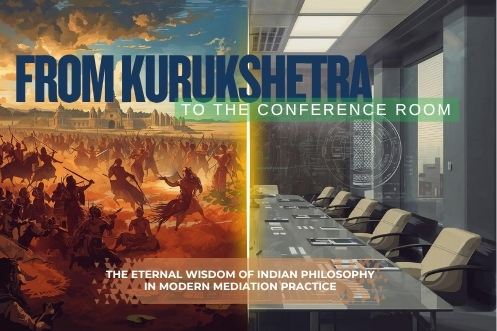
The Bhagavad Gita presents Lord Krishna as the quintessential mediator, guiding Arjuna through his profound crisis on the battlefield of Kurukshetra. Krishna’s approach embodies the highest principles of mediation and offers timeless lessons for contemporary practitioners.
Samatvam: The Definition of Yoga as Equanimity
The Gita’s most direct guidance for mediators appears in its definition of yoga itself:
योगस्थः कुरु कर्माणि सङ्गं त्यक्त्वा धनञ्जय । सिद्ध्यसिद्ध्योः समो भूत्वा समत्वं योग उच्यते
“Be steadfast in the performance of your duty, O Arjuna, abandoning attachment to success and failure. Such equanimity is called Yoga.”
This verse reveals that samatvam (equanimity) is not merely a recommended quality but the very essence of yoga. For mediators, this teaching provides both aspiration and method: remain equally balanced whether mediation succeeds or fails, whether parties agree or disagree, whether resolution comes quickly or takes time.
Contemporary research supports this ancient wisdom. Studies show that outcome attachment creates anxiety and may incentivize mediators to employ coercive tactics to secure settlements. By contrast, mediators who focus on process integrity rather than settlement rates maintain higher ethical standards and experience less professional burnout.
Nishkama Karma: Duty Without Attachment
The Gita’s principle of nishkama karma (selfless action) instructs practitioners to perform their duties skillfully while remaining unattached to results. For mediators, this means focusing on the quality of facilitation—ensuring fairness, managing power imbalances, maintaining confidentiality, fostering dialogue—without being motivated by personal rewards or reputation.
This approach addresses a critical challenge in modern mediation practice: the pressure to achieve high settlement rates. When mediators’ success is measured primarily by outcomes rather than process integrity, they may compromise ethical boundaries to force agreements. Nishkama karma liberates mediators from this pressure, anchoring their work in duty (dharma) rather than outcome (phala).
Sama Darshana: Equal Vision
Krishna embodies perfect impartiality, declaring:
समोऽहं सर्वभूतेषु न मे द्वेष्योऽस्ति न प्रियः
“I envy no one nor am I partial to anyone; I am equal to all.”
This stance of sama darshana (equal vision) represents the mediator’s highest ideal seeing all parties with equal respect and dignity regardless of their positions, behaviors, or social status. The Gita elaborates:
विद्याविनयसम्पन्ने ब्राह्मणे गवि हस्तिनि । शुनि चैव श्वपाके च पण्डिताः समदर्शिनः
“The wise see with equal vision a learned and humble Brahmin, a cow, an elephant, a dog, and even an outcaste.”
This teaching challenges mediators to transcend surface differences and recognize the inherent worth in all parties, seeing beyond positions to the deeper human needs that unite rather than divide.
The Sthitaprajna: One of Steady Wisdom
Arjuna asks Krishna to describe the sthitaprajna—one of steady wisdom:
स्थितप्रज्ञस्य का भाषा समाधिस्थस्य केशव । स्थितधीः किं प्रभाषेत किमासीत व्रजेत किम्
“O Keshava, what is the disposition of one who is situated in divine consciousness? How does an enlightened person talk? How does he sit? How does he walk?”
Krishna’s response describes someone undisturbed by pain, free from craving for pleasure, beyond attachment, fear, and anger—qualities enabling mediators to maintain presence and clarity amidst emotional intensity. This ideal represents the mediator’s aspiration: complete psychological equilibrium that allows for sound judgment regardless of external circumstances.
Integration: The Three Pillars of Transformative Mediation
The synthesis of these three classical texts yields a sophisticated, comprehensive model for advanced mediation practice. The integrated mediator operates simultaneously on three levels:
Metaphysical Lens (Yoga Vasistha)
Recognize that rigid positions and demands are expressions of ego (ahamkara) and mental constructs (manas), not ultimate reality. This perspective enables detachment from the perceived urgency and drama of conflict. Use facilitative inquiry (vichara) to guide parties from positions to underlying assumptions, from external disputes to internal attachments.
Internal Anchor (Bhagavad Gita)
Cultivate unconditional equanimity (samatvam) and commitment to duty without attachment to outcomes (nishkama karma). Maintain equal vision (sama darshana) toward all parties. Embody steady wisdom (sthitaprajna), remaining psychologically stable regardless of external volatility.
Interpersonal Skills (Patanjali Yoga Sutras)
Apply the four attitudes of maitri, karuna, mudita, and upeksha as precise tools for emotional regulation and effective facilitation. Practice ahimsa and satya as non-negotiable ethical foundations. Embody both steadiness and ease (sthira sukham) in physical presence and psychological stance.
Practical Implementation: From Theory to Practice
How can modern mediators operationalize these ancient principles?
Pre-Session Preparation: Before entering mediation, practice brief mindfulness meditation to cultivate chitta vritti nirodha (mental stillness). Set the intention to embody samatvam (equanimity) and sama darshana (equal vision) regardless of what unfolds.
During Sessions: When encountering positional bargaining, internally recognize it as ahamkara (ego-defense) rather than taking positions at face value. Use vichara (inquiry) questions to help parties examine underlying assumptions. Apply the four attitudes—maitri, karuna, mudita, upeksha—as appropriate to different personalities and behaviors.
Managing Difficult Behavior: When facing aggression or manipulation, cultivate upeksha (equanimity) to maintain impartial focus on process rather than reacting emotionally. Remember ahimsa (non-harming) to ensure your responses remain constructive rather than punitive.
Post-Session Reflection: Regardless of outcome, practice nishkama karma (detachment from results). Reflect on whether you maintained process integrity and ethical boundaries rather than measuring success solely by settlement achievement.
Ongoing Development: Establish regular meditation practice to cultivate the inner stability these texts prescribe. Consider studying these classical texts deeply to internalize their wisdom at a level beyond intellectual understanding.
The Timeless Path of the Conscious Mediator
The wisdom of the Yoga Vasistha, Patanjali Yoga Sutras, and Bhagavad Gita demonstrates that the essential qualities of transformative mediation have been understood and cultivated for thousands of years. These texts teach that genuine conflict resolution begins not with sophisticated techniques but with inner work—cultivating mental clarity, emotional regulation, ethical integrity, and unconditional equanimity.
Lord Krishna’s role as mediator and his identification of the madhyastha (one who stands in the middle) as worthy of highest respect confirms that mediation was understood in ancient India not merely as a practical skill but as a spiritual discipline. The mediator embodies the highest human capacities: wisdom, compassion, impartiality, and the ability to facilitate transformation.
Modern research validates what these ancient sages knew: emotional intelligence, mindfulness, compassion, and equanimity are not optional enhancements but essential foundations for effective mediation. Mediators who cultivate these qualities achieve significantly better outcomes, experience less burnout, and serve as catalysts for genuine transformation rather than mere settlement.
By embodying the metaphysical insight of Vasistha, the ethical discipline of Patanjali, and the unconditional equanimity of Krishna, mediators transform from a neutral facilitator into a conscious guide—standing steadily in the middle, undisturbed by the heat of conflict or the darkness of negativity, creating the space wherein parties can recognize their shared humanity and discover pathways to lasting resolution.
The journey from Kurukshetra to the conference room is not one of distance but of depth—from external technique to internal mastery, from procedural neutrality to consciousness-based transformation. This is the timeless path of the mediator who understands that the highest resolution of conflict occurs first within, then radiates outward to heal the world.