

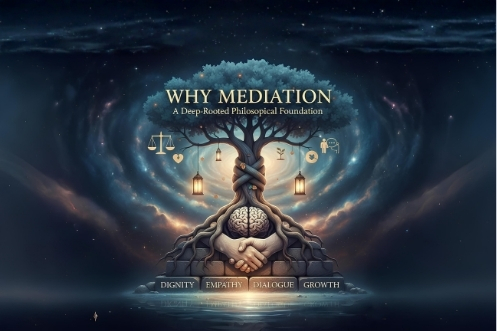
At its deepest level, mediation represents far more than a dispute resolution mechanism—it embodies a profound philosophical commitment to the inherent dignity and transformative potential of human beings. This understanding reveals mediation as both a practical tool and a sacred practice that honors the fundamental nature of consciousness, relationships, and human growth.
The Philosophical Core: Human Dignity as Foundation
Mediation rests upon the bedrock principle of human dignity—the recognition that every person possesses an inherent, unearnable worth that transcends their actions, positions, or circumstances. This dignity is not conditional upon being “right” or “wrong” in a dispute, but exists as an immutable aspect of human existence. When we engage in mediation, we affirm that each party deserves to be heard, understood, and treated with fundamental respect, regardless of the nature of their conflict.
The concept of human dignity serves as an “interstitial” bridge between law, ethics, and politics, creating a space where different normative systems converge around the shared recognition of human worth. In mediation, this translates into a process that honors both individual autonomy and relational interconnectedness—recognizing that humans are simultaneously independent moral agents and fundamentally interdependent beings.
Transformative Consciousness: Beyond Problem-Solving
The transformative approach to mediation reveals its deepest philosophical dimensions. Rather than merely solving problems, mediation facilitates fundamental shifts in consciousness—what theorists call “empowerment” and “recognition”. These are not superficial changes but profound transformations in how individuals relate to themselves and others.
Empowerment represents the restoration of one’s sense of personal agency, clarity, and strength. It is the recognition that despite being in conflict, one retains the capacity for self-determination and conscious choice. This aligns with the deeper spiritual understanding that conflict often arises from a temporary disconnect from our essential nature—our inner wisdom and strength.
Recognition involves the profound shift from self-absorption to openness toward the other. It is the capacity to see beyond one’s own perspective and truly comprehend the humanity, needs, and experience of another person. This mirrors spiritual teachings about the fundamental interconnectedness of all beings and the illusion of complete separation.
Conflict as Spiritual Opportunity
From this deeper perspective, conflict becomes a doorway to spiritual growth and expanded consciousness. Rather than viewing disputes as merely problems to be solved, mediation recognizes them as opportunities for what John Paul Lederach calls transformation at “physical, emotional and spiritual levels”.
This understanding draws from ancient wisdom traditions that see conflict as arising from ignorance of our true nature and interconnectedness. The Bhagavad Gita exemplifies this view—presenting conflict not as something to avoid, but as the very context in which dharma (righteous action) and self-realization unfold. Krishna’s guidance to Arjuna demonstrates how apparent external conflicts often reflect deeper internal struggles that, when properly understood, become catalysts for spiritual awakening.
The Healing Dimension: Restoration of Wholeness
Mediation operates within what Lois Gold describes as a “healing paradigm“, recognizing that conflict often represents a rupture in the fabric of relationships and community. The healing dimension goes beyond mere problem-solving to address the emotional, psychological, and spiritual wounds that both create and result from conflict.
This healing is not merely individual but systemic. Mediation creates what could be called a “Sacred Container” – a space where vulnerability is safe, truth can be spoken, and transformation can occur. This parallels the function of ritual in traditional societies, where community conflicts were addressed not just through legal decisions but through processes that restored harmony and collective wholeness.
Consciousness and the Seven Dimensions
Drawing from advanced spiritual psychology, mediation can be understood as operating across multiple dimensions of consciousness. While conventional legal processes primarily engage the third dimension (ordinary thoughts and emotions), mediation has the potential to access higher dimensions of awareness:
- Fourth Dimension: The perspective that sees conflicts within larger patterns and contexts
- Fifth Dimension: The realm of universal compassion and timeless understanding where creative solutions emerge
- Higher Dimensions: States of pure awareness where the illusion of separation dissolves
When mediators and parties access these expanded states of consciousness, solutions emerge that transcend the limitations of purely rational problem-solving. This explains why mediation often produces outcomes that neither party initially envisioned but which serve everyone’s deeper needs.
The Paradox of Non-Attachment
At its deepest level, mediation embodies the spiritual principle of non-attachment—engaging fully with the process while remaining unattached to specific outcomes. This paradox lies at the heart of effective mediation: the more we release our grip on predetermined solutions, the more space we create for authentic resolution to emerge.
This principle challenges the ego’s need to “win” or to be “right,” inviting parties instead into a space of genuine inquiry: “What wants to emerge here for the highest good of all?” This question shifts the focus from adversarial competition to collaborative discovery.
Mediation as Sacred Practice
Ultimately, mediation can be understood as a sacred practice—a contemporary form of what indigenous traditions might call “council” or “talking circle”. It creates a ritual container where the deepest human capacities for wisdom, compassion, and transformation can be accessed and expressed.
The mediator serves not merely as a neutral facilitator but as what might be called a “spiritual midwife“—helping to birth new possibilities that exist in potential but require the right conditions to manifest. This requires not just technical skills but qualities of presence, compassion, and wisdom that emerge from the mediator’s own spiritual development.
The Deeper “Why”: Evolutionary Imperative
From this expanded perspective, the question “Why mediation?” reveals its ultimate answer: mediation represents humanity’s evolution toward more conscious ways of relating. It embodies our species’ growing capacity to transform conflict from destructive force into creative catalyst.
In a world facing unprecedented challenges that require cooperation and mutual understanding, mediation offers a practical pathway for developing the consciousness necessary for our collective survival and thriving. Every mediation session becomes a small laboratory for practicing the kinds of skills—deep listening, empathy, collaborative problem-solving, win-win thinking—that our world desperately needs.
Integration: The Living Practice
This philosophical foundation is not merely theoretical but intensely practical. When we understand mediation’s deeper dimensions, every aspect of the process becomes infused with sacred purpose:
- Confidentiality becomes a container for sacred trust
- Voluntariness honors the fundamental freedom of consciousness
- Impartiality reflects the spiritual understanding that truth transcends individual perspectives
- Self-determination affirms each person’s connection to their inner wisdom
Through this lens, mediation emerges not as an alternative to litigation but as an invitation to conscious evolution—individually and collectively. It offers a pathway for transforming our relationship with conflict itself, seeing it not as something to fear or avoid, but as a sacred opportunity for growth, understanding, and the emergence of creative solutions that serve the highest good of all involved.
This is why mediation matters at the deepest level: because it serves not just our immediate need for dispute resolution, but our ultimate need for conscious, compassionate, and creative ways of being human together.