

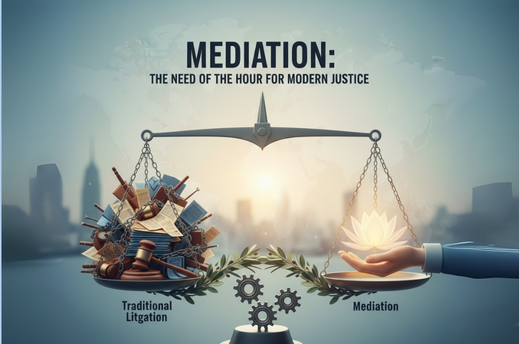
In an era marked by overburdened judicial systems and escalating disputes across personal, commercial, and institutional domains, mediation has emerged not merely as an alternative but as an essential solution for contemporary conflict resolution. With India’s courts struggling under the weight of over 5.1 crore pending cases and a critically low judge-to-population ratio of just 21 judges per million people, the time has come to embrace mediation as a cornerstone of accessible, efficient, and equitable justice.
The Crisis of Traditional Dispute Resolution
The statistics paint a stark picture of India’s judicial reality. The National Judicial Data Grid reveals an alarming backlog with over 82,000 cases pending in the Supreme Court, 62 lakh in High Courts, and nearly 5 crore in lower courts. This unprecedented backlog means that justice, often delayed by years, has become a luxury rather than a fundamental right for many citizens.
The traditional adversarial system, while having its merits, has proven inadequate in addressing the volume and complexity of modern disputes. Cases take an average of 1,445 days to resolve, creating a cascade of problems including increased costs, emotional trauma for parties, and a general erosion of public trust in the justice system. The situation is further compounded by the fact that nearly half of all pending cases involve the government as a litigant, highlighting the systemic nature of this crisis.
Mediation as a Transformative Solution
Mediation offers a paradigm shift from conflict to collaboration, transforming the way disputes are approached and resolved. Unlike traditional litigation, which focuses on determining winners and losers, mediation emphasizes mutual understanding, creative problem-solving, and relationship preservation. This collaborative approach has demonstrated remarkable effectiveness across various sectors and dispute types.
The benefits of mediation extend far beyond mere case disposal. Research indicates that mediation concludes cases more rapidly than traditional litigation, with settlement rates ranging between 24-29% nationwide. While these rates may seem modest, the impact is significant when considered against the backdrop of millions of pending cases. In 2023 alone, the Supreme Court Mediation Centre handled 1,095 cases—five times more than pre-pandemic volumes, demonstrating the growing acceptance and utilization of this mechanism.
Economic and Social Impact
The economic implications of choosing mediation over litigation are substantial. Court costs, legal fees, and the opportunity cost of prolonged disputes place enormous financial strain on individuals, businesses, and the state. Mediation offers a cost-effective alternative that not only reduces immediate expenses but also minimizes long-term economic impact through faster resolution and preserved business relationships.
From a societal perspective, mediation promotes collaborative problem-solving and maintains interpersonal relationships, essential elements for social harmony. In family disputes, commercial disagreements, and community conflicts, the ability to reach amicable settlements while preserving dignity and relationships proves invaluable for long-term social stability.
Global Growth and Market Dynamics
The global recognition of mediation’s value is reflected in market projections. The conflict resolution solutions market is expected to grow from $10.99 billion in 2025 to $17.76 billion by 2032, exhibiting a compound annual growth rate of 7.1%. This growth is driven by rising workplace disputes, increasing demand from the public sector, and growing preference for alternative dispute resolution.
In the workplace context, the relevance of mediation has become even more pronounced. Workplace disputes and personality clashes consume approximately 2.8 hours per employee per week, while 45% of employees reported a rise in identity-related conflicts in 2024. These statistics underscore the critical need for effective conflict resolution mechanisms in modern organizational settings.
Legislative Framework and Implementation
India’s commitment to mediation received formal recognition with the enactment of the Mediation Act, 2023. This landmark legislation provides a comprehensive framework for domestic mediation, establishing the Mediation Council of India and creating mechanisms for institutional mediation, mediator training, and enforcement of mediated settlements.
The Act represents a watershed moment in the Indian judicial system, elevating mediation from an ad-hoc practice to a formally recognized mode of dispute resolution. With provisions for online mediation, community mediation, and time-bound processes, the legislation addresses contemporary needs while respecting traditional dispute resolution practices.
Despite these positive developments, implementation challenges remain. Inadequate public awareness, lack of trained professionals, and limited infrastructure for institutional ADR continue to impede widespread adoption. The success of the Act will ultimately depend on enhanced legal literacy, institutional support, and greater policy integration.
Technology and Innovation
The integration of technology has opened new frontiers for mediation. Online Dispute Resolution (ODR) platforms have gained prominence, particularly following the COVID-19 pandemic, making dispute resolution more accessible and cost-effective. The Digital India initiative has led to the growth of ODR platforms, though this sector remains in its nascent stage with significant potential for expansion.
Artificial Intelligence is increasingly being integrated into conflict resolution processes, with capabilities to analyze communication patterns, identify potential disputes, and facilitate unbiased mediation. These technological advances promise to make mediation more efficient, accessible, and effective in addressing the scale of modern dispute resolution needs.
The Path Forward
For mediation to truly fulfill its potential as the need of the hour, several critical steps must be taken. Promoting ADR through legal education and awareness campaigns is essential to change public perception and increase adoption. Investment in training programs for mediators, arbitrators, and conciliators will enhance the quality and credibility of dispute resolution services.
Organizations must be encouraged to include ADR clauses in contracts to promote the use of mediation in commercial disputes. Government and judiciary must work collaboratively to strengthen regulatory frameworks while ensuring minimal court interference to preserve the autonomy and effectiveness of mediation processes.
The future of justice lies not in expanding traditional court infrastructure alone but in creating a hybrid ecosystem where mediation serves as the first line of dispute resolution, allowing courts to focus on complex matters that truly require judicial intervention. With over 16,000 trained mediators and nearly 600 dedicated centers already established across India, the foundation exists for a transformative shift in how society approaches conflict resolution.
Conclusion
Mediation represents more than just an alternative to traditional litigation—it embodies a fundamental reimagining of justice delivery that prioritizes accessibility, efficiency, and human dignity. As India grapples with an unprecedented judicial backlog and evolving social dynamics, mediation emerges as both a practical solution and a moral imperative.
The convergence of legislative support through the Mediation Act 2023, technological innovation through ODR platforms, and growing market demand creates an unprecedented opportunity to revolutionize dispute resolution. However, realizing this potential requires sustained commitment from all stakeholders—government, judiciary, legal professionals, and civil society—to promote, support, and participate in mediation processes.
In a world where time is justice and justice delayed is justice denied, mediation offers a beacon of hope. It promises not just faster resolution of disputes but a more compassionate, collaborative, and constructive approach to human conflict. The question is not whether mediation is the need of the hour, but whether we have the collective will to embrace this transformative approach to justice delivery that our times so desperately demand.